12 inch Balance Bike Ages (2-4yrs)
The Perfect First Bike for Toddlers Aged 2–4
Help your child build confidence and coordination with a 12 inch balance bike designed specifically for toddlers aged 2–4 years. Featuring lightweight frames, kid-specific geometry, and easy handling, these toddler bikes make learning to ride fun and frustration-free. By mastering balance first, little riders can transition to a pedal bike naturally—without the need for training wheels.
✔ Fast Shipping Australia-wide • ✔ 30-Day Love Your Ride Guarantee • ✔ 5-Year Bike Warranty • ✔ Learn-to-Ride Specialists Since 2008
Loved by Hundreds of Happy Parents and Grandparents!
 Rated 5.00 out of 5 based on 12 customer ratings(12)$229.00This product has multiple variants. The options may be chosen on the product page
Frequently Asked Questions of 12 inch Balance Bikes
A 12-inch balance bike is generally designed for children between 2 and 4 years old. The most important factor is your child's inside leg measurement rather than their age. Your child should be able to sit comfortably on the saddle with both feet flat on the ground. This allows them to push, balance and stop confidently, making learning both safer and more enjoyable.
Balance bikes help children learn the most important cycling skill first—balance. Instead of relying on stabilisers, children naturally develop coordination, steering and confidence by using their feet to move and stop. Many children who start on a balance bike transition to a pedal bike without needing training wheels, often making the process quicker and less stressful.
Start by measuring your child's inside leg from the floor to their crotch. Compare this measurement with the minimum seat height listed on the product page. Ideally, your child should be able to place both feet flat on the floor while sitting on the saddle. Adjustable seat and handlebar heights also allow the bike to grow with your child over several years.
When used correctly and under adult supervision, balance bikes are a safe way for young children to learn cycling skills. Children should always wear a properly fitted helmet, and many parents also choose gloves and knee or elbow pads for extra confidence. Riding on smooth paths, parks and quiet pavements provides the best environment for beginners.
A good balance bike should be lightweight, easy for a young child to control and fitted with an adjustable saddle and handlebars. Pneumatic or quality EVA tyres, a comfortable seat, child-friendly grips and a sturdy frame all contribute to a better riding experience. A lightweight bike is especially important because children can manoeuvre it more easily and parents can carry it when little legs get tired.
Most children are ready to move to a pedal bike once they can confidently glide, balance for several seconds and steer smoothly without putting their feet down frequently. This often happens between the ages of 3 and 5, although every child develops at their own pace. Because they've already mastered balance, many children skip stabilisers completely when moving to their first pedal bike.
Looking For Adventure and Insider Tips?
Here you’ll find tons of ideas and inspiration to make bike riding or skating with your child, even more fun!
Why Choose Our Quality Products For Your Child?
The Ultimate Guide to Choosing a 12-Inch Balance Bike for Ages 2–4 Years
Everything Parents and Grandparents Need to Know
Why a Balance Bike Is the Best Gift You Can Give a Toddler
If you’re searching for the best 12-inch balance bike for a 2-year-old, a toddler balance bike, or the best first bike for a 3-year-old, you’ve come to exactly the right place.At KidVelo, we believe that learning to ride a bike is one of the most joyful, confidence-building milestones in a young child’s life. Our 12-inch balance bike is specifically designed to make that milestone as exciting, safe, and natural as possible — for your child and for you.Whether you’re a parent buying your little one’s very first bike, a grandparent searching for the perfect birthday gift for a 2-year-old or Christmas gift for a 3-year-old, or a family member wanting to give the gift of outdoor adventure — this guide will give you everything you need to make a confident, informed choice.Let’s dive in.What Is a Balance Bike and How Does It Work?
A balance bike — sometimes called a running bike, push bike, strider bike, or toddler bike — is a two-wheeled bicycle with no pedals and no training wheels. Instead of pedalling, children propel themselves forward by walking or running with their feet along the ground.As their confidence builds, they begin to lift their feet and glide, naturally learning to balance on two wheels through instinct and repetition — the same organic way they learned to walk, run, and climb.This approach to learning is supported by child development research and is widely recommended by paediatricians, physiotherapists, and childhood development specialists as the most effective and natural way to introduce cycling to young children.The 12-inch wheel size is specifically calibrated for children aged 2 to 4 years, providing the ideal combination of stability, manoeuvrability, and proportional fit for toddler-sized bodies.The Development Benefits of Balance Bikes for Toddlers
Beyond simply learning to ride a bike, a 12-inch toddler balance bike offers a remarkable range of developmental benefits that many parents and grandparents are surprised to discover.🧠 Cognitive Development
Learning to balance, steer, and judge speed and distance is genuinely complex cognitive work for a young child. Riding a balance bike challenges and develops spatial awareness, cause-and-effect thinking, and problem-solving as children navigate paths, corners, and obstacles.💪 Physical Development
Balance biking is a full-body workout perfectly suited to toddlers. It builds:- Core strength and stability — essential for overall physical health
- Leg strength — from pushing, gliding, and braking
- Gross motor skills — coordination of large muscle groups
- Balance and proprioception — the body’s ability to sense its own position in space
😊 Emotional and Social Development
There are few things more confidence-boosting for a toddler than mastering a new physical skill. The progressive nature of balance biking — where children set their own pace and experience clear, visible improvement — builds self-esteem, resilience, and independence.Riding alongside siblings, friends, or parents also creates wonderful opportunities for social play, turn-taking, and shared adventure.🌿 Encouraging Outdoor Activity
In an era of screens and indoor entertainment, a balance bike is a powerful tool for encouraging children to love the outdoors from an early age. Children who develop positive associations with active outdoor play at ages 2–4 are significantly more likely to maintain active, healthy lifestyles throughout childhood and beyond.How to Choose the Right 12-Inch Balance Bike: The Complete Buyer’s Guide
With so many options available, choosing the best balance bike for a 2-year-old or best balance bike for a 3-year-old can feel overwhelming. Here’s exactly what to look for.1. Seat Height and Inseam Fit — The Most Critical Factor
The single most important measurement when selecting a balance bike is seat height relative to your child’s inseam.To measure your child’s inseam:- Have your child stand barefoot against a wall
- Place a book between their legs, spine upward, as if sitting on a saddle
- Measure from the top of the book to the floor
2. Frame Material — Lightweight Is King
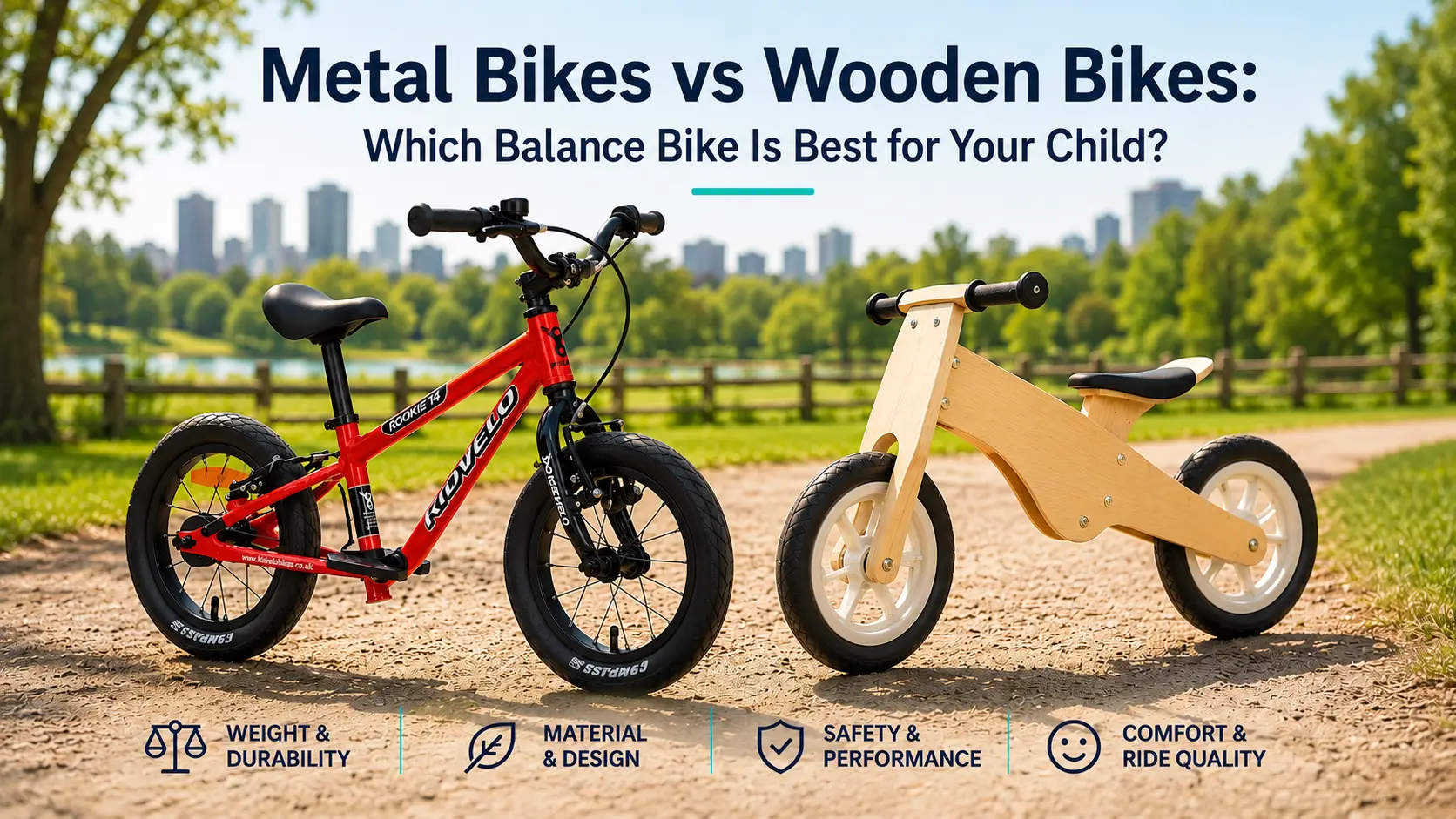
As discussed in our FAQs, frame weight is critical for toddlers. The most common frame materials are:- Steel — Durable and cost-effective, but heavier. Fine for older children but can be cumbersome for 2–3-year-olds.
- Aluminium — Lightweight, rust-resistant, and ideal for young children. This is what we recommend for the 2–4 age group.
- Wood — Aesthetically beautiful and lightweight, but can be susceptible to weather damage and typically offers less adjustability.
- Composite/Carbon — Extremely lightweight but expensive and less common in the toddler category.
3. Tyre Type — Pneumatic vs. Foam
Choose air-filled rubber tyres over foam/EVA tyres wherever possible. The difference in ride quality, grip, and comfort is significant — particularly on the varied surfaces (grass, gravel, paths, driveways) that toddlers encounter daily.Yes, pneumatic tyres can theoretically get a puncture — but this is rare with proper use, and the superior riding experience is well worth it.4. Handlebar Design and Grips
Look for:- Ergonomic, child-sized grips that are easy for small hands to hold
- Protective end caps on handlebar ends (essential safety feature)
- Adjustable handlebar height — a bonus feature that extends the bike’s usable life
5. Footrest/Gliding Platform (Optional but Valuable)
Some quality balance bikes include a footrest or gliding platform between the wheels. As children become more confident, they can rest their feet here while gliding — a brilliant feature that helps bridge the gap between pushing and fully lifting their feet. It also encourages longer gliding sessions, which accelerates balance development.6. Brakes — Do Toddler Balance Bikes Need Them?
This is a topic of genuine debate in the balance bike world.For younger riders (2 years old), hand brakes are often unnecessary — children naturally use their feet to slow down and stop, which is intuitive and effective.For older riders in the 3–4 age range, a simple rear hand brake can be a valuable introduction to brake mechanics before they transition to a pedal bike. It also helps on steeper inclines.If you’re buying for a 2-year-old beginner, foot braking is perfectly sufficient. If your child is 3+ or already reasonably confident, a brake is a worthwhile feature.7. Adjustability and Longevity
A quality balance bike should grow with your child. Look for:- Multiple seat height settings or a wide-ranging seat post
- Adjustable handlebar height
- Durable components that will withstand 1–2 years of enthusiastic use
12-Inch Balance Bike vs. Other Sizes — Which Is Right?
| Bike Size | Recommended Age | Inseam Range | Best For |
|---|---|---|---|
| 10-inch | 18 months – 2.5 years | 28–35cm | Very young starters |
| 12-inch ✅ | 2 – 4 years | 30–42cm | Most toddlers — best-selling size |
| 14-inch | 3 – 5 years | 38–50cm | Taller 3–4-year-olds |
| 16-inch | 4 – 6 years | 45–55cm | Transitioning to pedal bikes |
When Will My Child Be Ready to Transition to a Pedal Bike?
One of the most exciting moments for any family is watching a child make the leap from balance bike to pedal bike. And for balance bike graduates, this transition is remarkably smooth.Signs your child is ready to move to a pedal bike:- They’re consistently gliding with feet fully off the ground for 5+ seconds
- They can steer confidently and avoid obstacles
- They’re showing interest in pedalling
- They’re physically outgrowing the balance bike (feet dragging awkwardly, knees too high)
Why Choose Kidvelo Bikes?
At Kidvelo Bikes, we’re passionate about one thing: giving children the very best start in their cycling journey.Our 12-inch balance bike has been designed from the ground up with input from parents, child development specialists, and cycling enthusiasts. Every detail — from the lightweight frame and quality pneumatic tyres to the ergonomic grips and adjustable seat — has been chosen with your 2–4-year-old’s experience and safety in mind.We believe every child deserves a bike that:- Fits them properly so they feel safe and in control
- Weighs appropriately so it’s fun rather than frustrating
- Performs beautifully on real surfaces in the real world
- Lasts long enough to deliver genuine value for your family